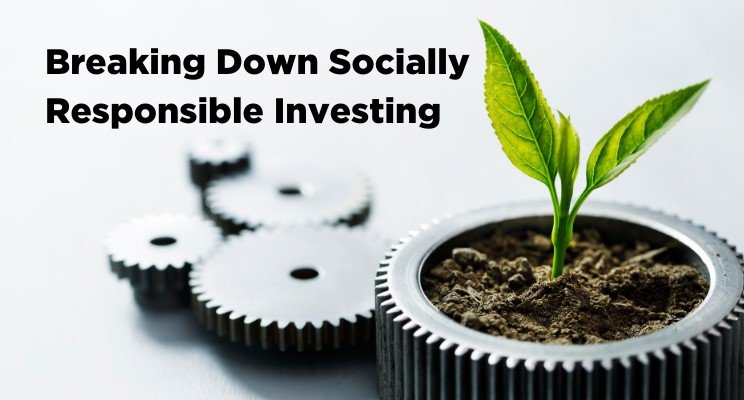
Breaking Down Socially Responsible Investing
Many investors want more out of their investments than just a good return. They want to know that the companies they invest in are ethical and responsible — that they build environmentally sustainable business models, advance a social good and operate in a transparent, ethical way. To identify these companies, socially responsible investors can use a set of criteria known as ESG.
ESG basics
ESG is short for environmental, social and governance. Investors can use each element of this framework to screen their investments and build a socially responsible portfolio. Here’s a closer look:
- Environmental issues include emissions and pollution, climate change, water conservation and renewable energy. Corporations demonstrate environmental responsibility by setting goals to decrease their negative impact on the environment and by showing progress.
- Social issues include diversity and inclusion, poverty, worker exploitation and human rights. Corporations demonstrate social responsibility by recruiting a diverse workforce, maintaining a safe work environment, compensating fairly, protecting the communities they operate in and holding the companies they do business with to similar standards.
- Governance issues revolve around the internal workings of the corporation. Some, such as employee treatment and compensation and diversity among corporate leadership, overlap with social issues. But governance is broader than that. ESG investors favor companies that communicate transparently with shareholders, divide power among different positions with different perspectives, and guard against nepotism and corruption.
The ESG framework gained popularity in the 2000s with the rise of socially responsible investing. It was largely fueled by two reinforcing factors: Investors were becoming increasingly interested in the social and environmental impacts of their portfolio companies, and the long-held notion that corporate responsibility hurt profits was overtaken by the theory that responsible practices actually improve a company’s long-term prospects and reduce risk. Consider that 57 of Morningstar’s 65 ESG-screened market indices have outperformed their ESG-indifferent counterparts over the past five years.
What gives companies that meet ESG criteria a competitive edge? It may be that businesses that rely on sustainable sources of energy and materials are naturally more fit for long-term survival. Those that treat their workforce well may improve employee productivity, decrease turnover and avoid bad press and lawsuits. And companies with good governance practices may ensure competent leadership, avoid scandal and increase shareholder returns by reducing executive salaries and bonuses.
Building a responsible portfolio with ESG funds
You may not feel you have the time or expertise to independently evaluate the ESG performance of every stock you might want in your investment portfolio. Many ESG investors rely on ESG-focused index funds, mutual funds and exchange-traded funds to build a balanced, diversified, socially responsible portfolio.
An ESG fund may still hold stock in companies you don’t agree with for moral or ethical reasons, such as distilleries, weapons manufacturers or casinos. These companies may perform well on an ESG evaluation, so if you have qualms with certain industries, be sure to seek out an ESG fund that specifically excludes them.
There is no universal ESG standard, so it’s important to read the prospectus of the fund you’re considering to understand what criteria a fund is using. Commonly found on a fund’s website, the prospectus gives detailed information about how the fund operates, detailing its objectives, risks, fees and expenses. The Securities and Exchange Commission also maintains a searchable database of fund prospectuses. You may also consult a financial advisor to help you determine which ESG funds meet your objectives and are appropriate for your portfolio.
Sources:
- https://www.morningstar.com/insights/2021/02/08/morningstars-esg-indexes-have-outperformed-and-protected-on-the-downside
- https://www.sec.gov/edgar/searchedgar/prospectus.htm
- Environmental Finance. (2004). United Kingdom: Fulton Pub. Limited.
- https://www.reuters.com/article/us-usa-guns-blackrock/investors-embrace-esg-investing-but-dont-target-gun-stocks-idUSKCN1UZ22J
- https://www.ussif.org/article_content.asp?edition=1§ion=3&article=19
Material prepared by The Oechsli Institute, an independent third-party. Investing involves risk and you may incur a profit or loss regardless of strategy selected. Utilizing an ESG investment strategy may result in investment returns that may be lower or higher than if decisions were based solely on investment considerations.